


SEO vs PPC
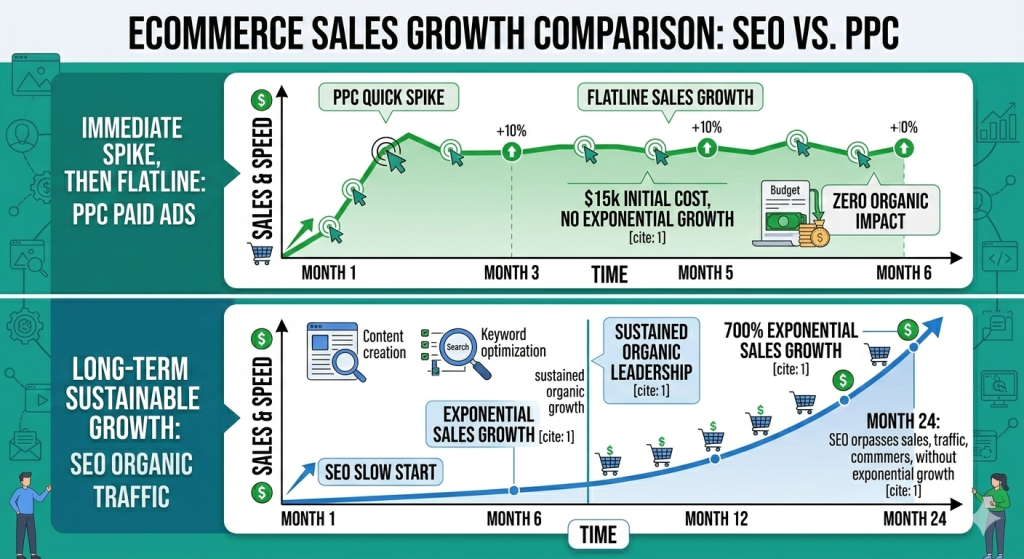
For e-commerce businesses in 2026, deciding between SEO vs. PPC (Pay-Per-Click) advertising (mainly Google Ads and Shopping) comes down to one key question: Do you need sales right now or sustainable, compounding revenue over time?
Short answer:
- PPC wins for immediate sales — perfect for new launches, seasonal peaks, or quick revenue boosts.
- SEO generates more total sales in the long term — often with higher lifetime value, lower costs, and better margins once rankings mature.
Most successful US e-commerce stores (mid-market and scaling brands) use a hybrid approach: PPC for fast cash flow and testing and SEO for long-term dominance. Here’s the data-driven breakdown based on 2025–2026 benchmarks from sources like FirstPageSage, Click-Vision, SeoProfy, and industry reports.
Why the Debate Matters for E-commerce Sales
E-commerce traffic splits roughly:
- Organic (SEO): ~40–43% of total traffic, but often 60–70% of off-season conversions.
- Paid (PPC): 23–30% of traffic but dominates during promotions and spikes.
The goal isn’t “SEO or PPC” — it’s maximizing sales while controlling costs. Organic traffic compounds (no per-click fees), while PPC scales instantly, but costs rise with competition.
1. Time to Sales & Speed: PPC Dominates Short-Term
If your store needs revenue this week or month, PPC is the clear choice:
- Ads live in hours → sales in days.
- Ideal for new products, flash sales, or testing demand.
- Google Shopping + Performance Max campaigns can drive immediate purchases on high-intent searches like “buy wireless headphones online.”
PPC shines during Black Friday or holidays, capturing 60–70% of seasonal demand spikes.
2. Long-Term Sales & Total Revenue: SEO Pulls Ahead
After 6–18 months, SEO often overtakes PPC in cumulative sales:
- Traffic becomes “free” after initial investment (content, technical fixes, and links).
- Average e-commerce SEO ROI: 317–447% (3–8x return) over 12–24 months.
- Organic buyers show higher lifetime value and repeat rates due to built-in trust (no “ad” label).
- Off-season: Up to 70% of conversions can come from organic in mature stores.
Many marketers (70% in polls) report that SEO generates more sales overall than PPC once established.
3. Conversion Rates & Buyer Quality
- SEO: 1.6–2.4% average (higher trust from top organic positions).
- PPC: 1.3–3.75% (Shopping ads often 4–5% on transactional queries).
Slight edge to SEO for trust and repeat buys, but PPC excels on exact-match intent (e.g., “best price air fryer”).
4. Cost & ROI Breakdown
- SEO: Upfront costs (content, tools, links) → near-zero ongoing per visitor. Break-even in 6–12 months.
- PPC: Ongoing per-click spend (rising CPCs in competitive niches) → predictable but expensive at scale.
Long-term winner: SEO (compounding returns). Short-term: PPC (quick payback).
5. Best Scenarios for Each in E-commerce
Choose PPC-heavy if:
- New store or product launch.
- High competition for keywords.
- Seasonal business or promotions.
- Need fast validation and cash flow.
Choose SEO-heavy if:
- Evergreen products (fashion, electronics, supplements).
- Focus on margins and brand building.
- Can invest 6–12+ months.
- Want lower customer acquisition costs over time.
The Winning Strategy: Hybrid SEO + PPC for Maximum Sales
In 2026, top e-commerce winners don’t pick on—theyy stack both:
- Use PPC (40–60% budget) for quick wins, shopping ads, remarketing, and testing.
- Invest in SEO (40–60% effort) for category/product pages, content, and authority → compounding traffic.
- Use PPC data (winning keywords, ad copy) to fuel SEO content.
This hybrid delivers higher total revenue, lower risk, and balanced growth.
Ready to see which is underperforming in your store?
Book a free e-commerce audit with EcomnDe—we’ll analyze your SEO vs PPC split and map exact sales opportunities.
FAQ
Which generates more sales for e-commerce: SEO or PPC?
PPC for immediate/short-term sales; SEO for more total/long-term sales and better margins.
What is the average conversion rate of SEO vs. PPC in e-commerce?
SEO: 1.6–2.4%; PPC: 1.3–3.75% (Shopping ads higher).
Is SEO worth it for e-commerce in 2026?
Yes, 70% of marketers say it generates more sales than PPC long-term, with 3–8x ROI.
Should e-commerce stores use both SEO and PPC?
Absolutely — hybrid strategies outperform single-channel approaches for revenue and stability.