

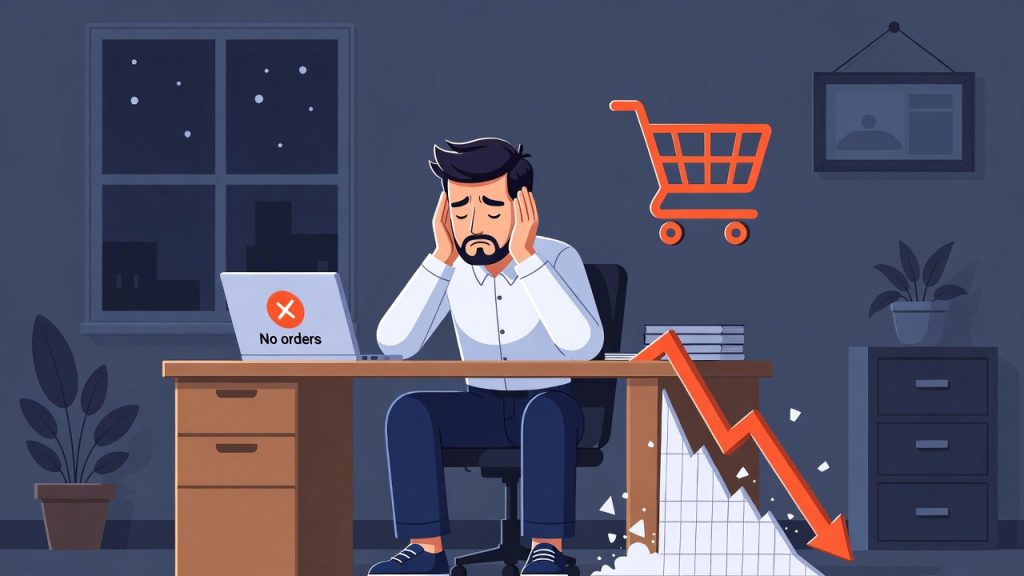
10 Reasons Why No Online Orders for Your E-commerce Store.
You have an online shop.
You have great products.
You might even have a website or online store.
But still… no online orders.
It’s frustrating—and unfortunately, very common.
In 2026’s competitive e-commerce landscape, simply having a website isn’t enough. The global average e-commerce conversion rate hovers around 2-3% (with many sources citing 2.5-3% for established stores), meaning 97-98% of visitors leave without making a purchase. Cart abandonment rates sit at 70-78% globally (Baymard Institute and recent 2026 data), often due to hidden costs, slow loading, or trust issues.
Most struggling shops share the same 10 critical mistakes. Fix even a few, and you could see orders double or triple.
In this guide, we cover each major reason—with real explanations and actionable fixes you can start today. For faster results, consider partnering with a professional digital marketing company or e-commerce setup company.
1. Why No Online Orders Start with a Weak E-commerce Setup
Many owners use cheap builders or basic templates that result in the following:
- Slow loading times
- Poor mobile performance
- Buggy or complicated checkout
- Missing trust elements (SSL, badges, reviews)
Without a solid foundation, no amount of marketing will convert visitors.
How to Fix It:
- Hire a professional e-commerce setup company to build a conversion-focused store (e.g., on Shopify or WooCommerce).
- Prioritize mobile-first design; mobile will drive ~60%+ of e-commerce traffic and sales in 2026.
- Enable guest checkout, one-click options (Apple Pay/Google Pay), and visible trust badges.
A weak setup wastes every ad dollar and organic click.
2. Your Website Is Not Optimized for Search Engines
If customers can’t find you on Google, they can’t buy from you.
Without proper search engine optimization (SEO):
- Zero or minimal organic traffic
- Competitors dominate search results
- Heavy reliance on paid ads
How to Fix It:
- Conduct keyword research (use free tools like Google Keyword Planner or suggestions).
- Fix technical SEO: mobile-friendliness, site speed, and schema markup for products.
- Optimize product pages with unique titles/descriptions, keyword-rich alt text, and internal links.
- Add local SEO if you have a physical location.
A skilled digital marketing company delivers steady, free traffic through expert search engine optimization.
3. You’re Not Running PPC Ads Properly
Many say, “Ads don’t work for me.”
The real issue? Poor strategy wastes budget on clicks without sales.
How to Fix It:
- Target high-intent audiences (look-alikes, interests, and remarketing).
- Set up accurate conversion tracking (Google Analytics 4 + pixels).
- Run retargeting for cart abandoners.
- Optimize for ROAS (aim for 4x+ return).
A data-driven digital marketing agency manages PPC campaigns that deliver profitable orders, not just traffic.
4. No Search Engine Marketing Strategy
SEO takes time to build momentum.
Skipping Search Engine Marketing (SEM) means missing ready-to-buy shoppers searching right now.
How to Fix It:
- Combine SEO (long-term) with SEM (Google Ads) for immediate high-intent traffic.
- Bid on transactional keywords (e.g., “buy [product] online”).
- Use Shopping Ads to showcase products directly in results.
This hybrid approach accelerates growth significantly.
5. Poor Product Page Optimization
Your product page isn’t just a listing—it’s your #1 salesperson.
Common problems: feature lists instead of benefits, low-quality images, weak CTAs, and no urgency or trust.
How to Fix It (E-commerce Sales Optimization):
- Focus on benefits: how it solves the customer’s problem.
- Use high-res photos (multiple angles, zoom, and lifestyle shots).
- Add trust: star ratings, reviews, and security seals.
- Strong CTAs + urgency: “Add to Cart—Limited Stock” or countdown timers.
Optimized pages can boost conversion rates 2-3x.
6. No Social Proof = No Trust
Today’s buyers check reviews, testimonials, and brand signals before purchasing.
If your store looks new, inactive, or unproven, hesitation wins.
How to Fix It:
- Collect and display reviews (Google, Trustpilot, and on-site).
- Add video testimonials or user-generated content.
- Stay active on social media (Instagram/Facebook shops).
- Show authority badges (“As Seen On” or certifications).
A digital marketing company builds trust across platforms to reduce buyer hesitation.
7. Your Website Is Too Slow
Even 1 extra second of load time can cause significant sales loss—shoppers won’t wait more than 3 seconds (with 40%+ abandoning slow sites).
Slow speed hurts user experience, SEO rankings, and conversions.
How to Fix It:
- Test with Google PageSpeed Insights (aim for a 90+ score).
- Compress images (TinyPNG) and enable lazy loading.
- Use reliable hosting (e.g., Cloudways/SiteGround) + CDN.
- Optimize Core Web Vitals (LCP < 2.5s, etc.).
Speed directly impacts revenue—fix it first.
8. You’re Not Retargeting Visitors
98% of visitors don’t buy on their first visit.
Without retargeting, you lose them forever.
How to Fix It:
- Install Facebook/Google pixels for tracking.
- Run dynamic retargeting ads (show products they viewed).
- Set up automated emails/SMS for abandoned carts (tools like Klaviyo).
- Expect 10-15% recovery from good sequences.
Retargeted visitors convert up to 70% better.
9. No Clear Sales Funnel
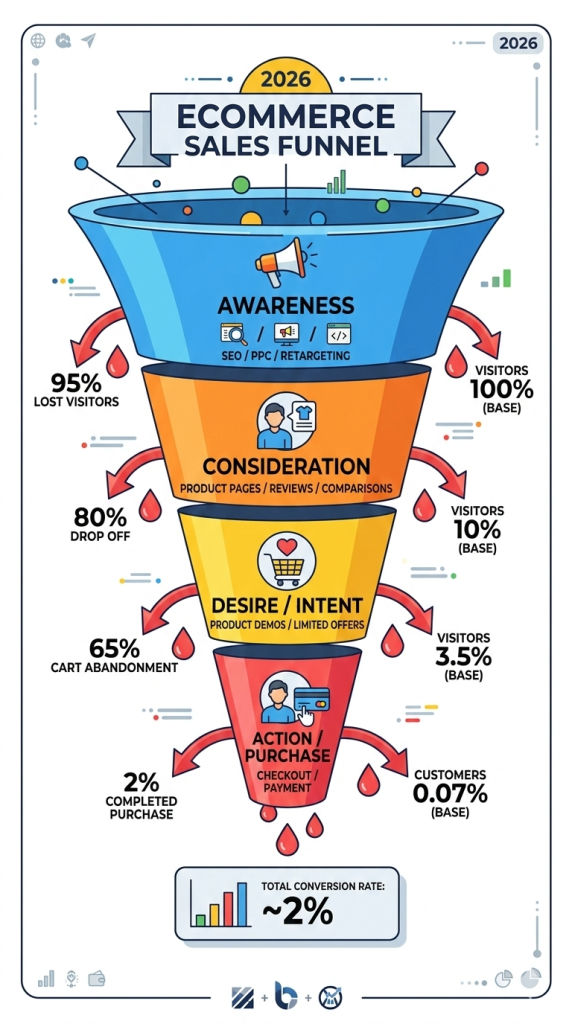
Random marketing leads to random (or zero) results.
No structured path from visitor to buyer to repeat customer.
How to Fix It:
- Build a funnel: Traffic (SEO/PPC) → Engagement (content/social) → Retargeting → Conversion → Upsell.
- Use abandoned cart recovery and exit-intent popups.
- Add cross-sells/upsells at checkout.
A professional e-commerce setup company and an e-commerce sales optimization strategy create scalable systems.
10. You’re Trying to Do Everything Yourself
Wearing all hats—ads, SEO, design, fulfillment—leads to burnout and mediocre results.
How to Fix It:
- Delegate to experts: hire a digital marketing agency for strategy and execution.
- Focus on your strengths (products, customer service).
- Start small: get a full audit and focus on 1-2 high-impact areas (e.g., SEO and PPC).
Pros build repeatable systems that drive consistent growth.
Conclusion
These 10 issues explain why so many online shops struggle with orders in 2026. The good news? Every single one is fixable.
Quick wins to start:
- Check and improve site speed and mobile experience.
- Optimize product pages and add social proof.
- Set up abandoned cart retargeting (email/SMS).
If you’re tired of guessing and trial-and-error, book a free e-commerce audit with our digital marketing agency. We’ll pinpoint exactly where sales are leaking and give you a clear roadmap to more orders.
Drop a comment: What’s the biggest challenge you’re facing right now? Or check out our related guide: “Best PPC Strategies for Small Shops in 2026.”